
October 22, 2026
Premier Bin rental Service in Toronto and the GTA
Last updated:
We’re taking a close look at the linguistics and vocabulary used worldwide when renting renovation waste containers. Language is a fascinating reflection of culture, and the words we use to describe our daily habits often have rich, unexpected histories.
Our journey leads us from the busy streets of North America to the historical avenues of Europe and the lively cities of Asia. Everywhere we go, we find a variety of terms that reveal unique linguistic roots. Let’s explore the international nomenclature and etymology of waste containers.
In the United States and much of North America, the term “dumpster” is universally used to refer to large, steel waste containers. However, most people don’t realize that “Dumpster” is actually a genericized trademark, much like Kleenex or Hoover.
The word was coined in 1936 by the Dempster Brothers (George, Thomas, and John) in Knoxville, Tennessee. They invented a system of mechanically loading standardized metal containers onto garbage trucks, which they patented as the Dempster-Dumpster system. The name was a simple portmanteau of their last name “Dempster” and the word “dump.” Over the decades, the brand name became so popular that it entered the lower-case English dictionary as the standard word for the object itself.
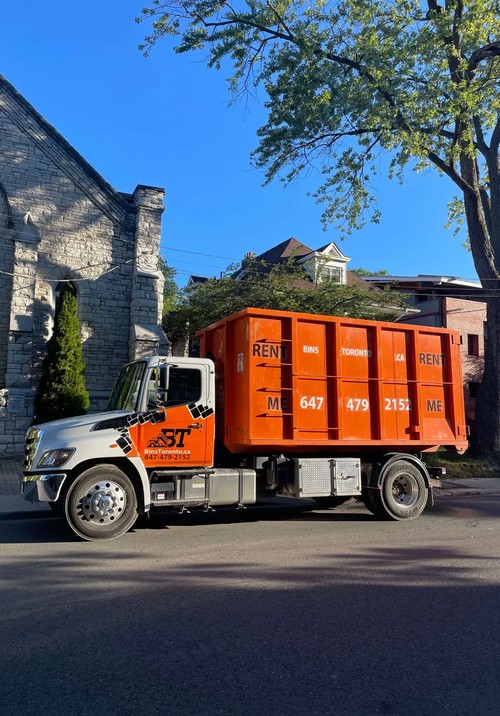
Within Canada, especially in Toronto and the Greater Toronto Area, the term “bin” is used almost interchangeably with “dumpster.” This reflects Canada’s unique position of having diverse linguistic influences, sitting right at the crossroads of American terminology and British English traditions.
Heading across the Atlantic to the United Kingdom, Ireland, and Australia, you will rarely hear the word dumpster. Instead, large construction and renovation containers are referred to as “skip bins” or simply “skips.”
The etymology of “skip” is entirely different from the American version. It derives from the late Old English word skep, which originally referred to a large woven basket used in farming and mining to carry heavy loads of coal or grain. When heavy industry modernized, the woven baskets were replaced by massive steel boxes, but the historical term “skip” survived.
In France, the word for a garbage can or waste container is “poubelle.” Unlike descriptive words, this term is an eponym—a word derived from a person’s name.
In 1884, Eugène Poubelle, the Prefect of the Seine (the government official in charge of Paris), issued a landmark decree to improve urban hygiene. He mandated that all building owners must provide their tenants with covered, localized containers for their daily refuse to stop people from throwing it into the streets. The media and the public quickly began sarcastically referring to these mandated receptacles as “boîtes Poubelle” (Poubelle’s boxes). The sarcasm faded, but the name stuck permanently in the French language.
Moving to Asia, particularly in countries like Japan and South Korea, the terminology is highly functional, reflecting a cultural emphasis on cleanliness and distinct categorization.
In the German language, practicality reigns supreme. The term “Mülltonne” is used for large rolling containers, directly translating to “garbage barrel.” For smaller, everyday receptacles, the term “Abfalleimer” (waste bucket) is standard. Germany’s language reflects its globally recognized efficiency in urban organization.
Whether you call it a dumpster, a skip, a poubelle, or a bin, the need for efficient, heavy-duty project management remains universal. As a trusted provider serving the Greater Toronto Area, we stand ready to offer our professional services under the Canadian banner of “Bins.”
Whether you’re undertaking a residential cleanup or a commercial renovation, our fleet is tailored to accommodate your specific requirements. Contact Bins Toronto today, and we’ll ensure your project stays clean and organized, no matter what vocabulary you prefer to use.