
March 20, 2026
Premier Bin rental Service in Toronto and the GTA
December 15, 2025
If you have ever stared at a heavy steel bin and wondered how to protect your driveway from dumpster damage, you are asking the right question. There is a specific kind of excitement that comes with ordering a dumpster. It means you are finally starting that big project. Maybe you are ripping out that dated 1970s kitchen in North York, or perhaps you are finally clearing out a hoarding situation in the basement. The bin arrives, you fill it up, and you feel a massive sense of relief as the truck drives away with your junk. But then, you look down.
And that sense of relief develops into an ache in your stomach. There are four deep dents in your asphalt in the center of your driveway. Or perhaps that beautiful interlocking stone has a long, rusty orange streak. We at Bins Toronto have witnessed this situation more times than we would like to acknowledge. Because it is entirely avoidable, it always breaks our hearts. This is a comprehensive guide that covers every aspect of protecting a driveway when renting a dumpster, from the summertime heat to the kind of plywood you should purchase.
You need to know what causes the damage to stop it. “It’s just a metal box; my car weighs 4,000 lbs, and my driveway is fine,” is what most people believe. What makes this unique?
The difference comes down to two things: Static Weight and Point Load.
Four air-filled rubber tires distribute the weight of your car when it is parked. Each tire has a comparatively large “footprint” that disperses the weight. A dumpster is not the same. A typical 20-yard dumpster is constructed from heavy-gauge, sturdy steel. It weighs roughly 3,000 pounds when empty. However, that can soar to 8,000 pounds or more once you fill it with heavy drywall, old lumber, wet carpet, and renovation debris.
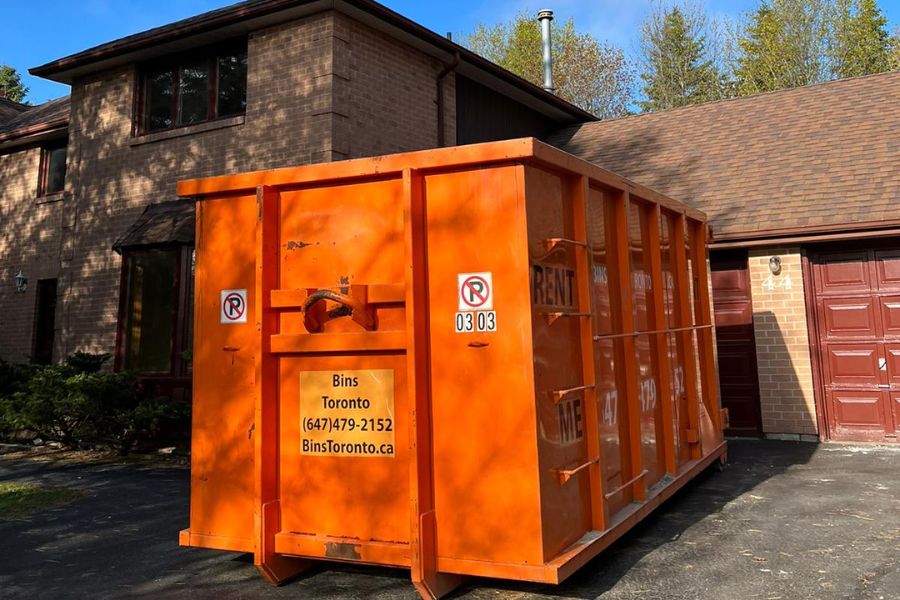
Now, imagine all that weight resting not on rubber tires, but on four small steel wheels or two narrow steel rails. The pressure per square inch (PSI) is massive. It’s the difference between someone stepping on your foot in a sneaker versus a stiletto heel.
If you take nothing else away from this guide, remember this rule: Steel should never touch stone.
The industry standard for preventing marks is using wood planks. But you can’t just grab some old cardboard boxes or a blue tarp and call it a day. Those materials offer zero structural resistance against 4 tons of pressure. You need wood that can sacrifice itself to save your asphalt.
Not all dumpsters are built the same. Some roll on four wheels; others sit on two long rails running the length of the bin. This changes your strategy for dumpster damage prevention.
For Wheel Bins: You need a plank under each wheel. The tricky part is predicting exactly where the wheels will land. It’s better to lay down a longer strip of wood (4 feet long) so the driver has some margin for error.
For Rail Bins: You need to place planks across the width of the driveway (perpendicular to the bin). You usually want three planks: one at the front, one in the middle, and one at the back. This keeps the entire rail lifted off the ground.
In Toronto, we deal with three main driveway types. Each one has a specific weakness you need to guard against. Knowing your surface material is half the battle when figuring out how to protect a driveway from dumpster damage effectively.
Asphalt is essentially gravel glued together with tar. It is flexible, which is great for winter freeze-thaw cycles, but terrible for point loads. The biggest enemy of asphalt is Heat.
In July and August, when Toronto temperatures hit 30°C, your black driveway absorbs heat and can reach surface temperatures of 60°C. At that heat, asphalt becomes soft, almost like stiff putty. If you put a heavy bin on it without wide plywood dispersion, the wheels will sink. When we pick up the bin, you will be left with four permanent divots that hold water and eventually turn into potholes.
The Fix: On hot days, use wider plywood sheets (4×4 feet) to spread the weight as much as possible. Try to place the bin in a shady spot if you can.
Concrete is rigid and strong. It won’t sink like asphalt, but it has a different weakness: Tensile Strength. Concrete is great at handling compression, but if you put too much weight on a corner or an edge, it will snap.
The danger zone for concrete is the edges of the slabs. If a dumpster wheel lands right on the seam between two slabs, it can act like a lever, cracking the corner off.
The Fix: Guide the driver to center the bin in the middle of a slab, avoiding the expansion joints and edges.
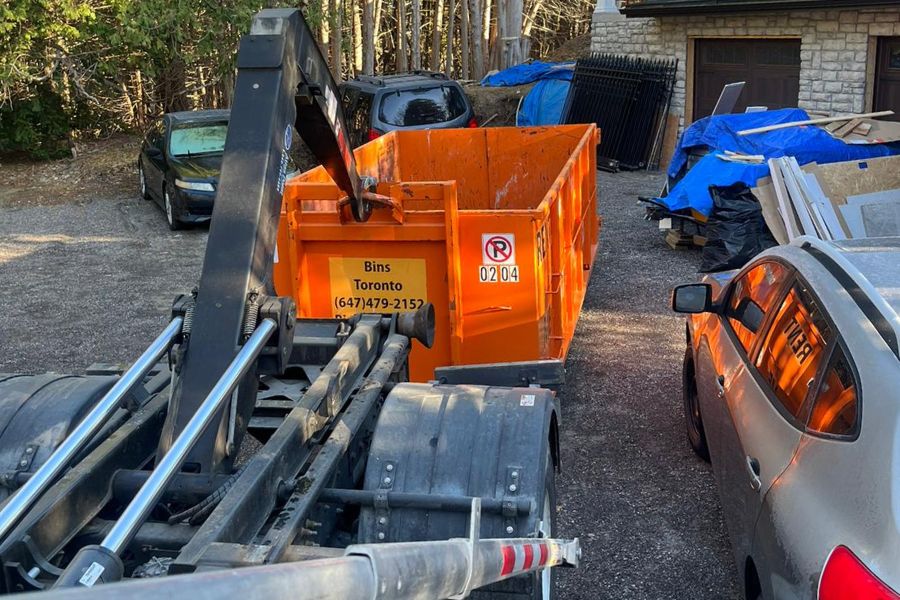
Pavers are costly and elegant. The danger here is usually shifting the stones rather than cracking them, though that can happen. A wavy, uneven surface may result from the stones being pushed out of alignment by the truck’s tires turning or the bin sliding.
The Fix: Cover the entire area with a tarp under the plywood. Why? Because rusty water or oil dripping from the bin can stain the porous stone, which is nearly impossible to clean. The plywood protects the structure; the tarp protects the aesthetics.
Alright, so your wood planks are in place. Even with the best protection, operational errors can still harm your driveway.
Your driveway might not be able to support it, even if the truck can physically lift it (which is questionable). The majority of residential driveways have a thickness of three to four inches. They are not made for industrial loads, but rather for automobiles. Overloading a bin could cause the driveway’s foundation to crack, resulting in a deep structural failure that surface repaving won’t be able to address.
The Rule: If you are disposing of “dense” materials like dirt, concrete, or brick, you usually cannot fill the bin to the top. Stick to the fill lines.
This is a situation that people hardly ever think about: For a week, you rent a bin. It’s a typical Toronto downpour, with three days of nonstop rain. The bin was not covered by you.
The interior debris, which includes insulation, drywall, and old carpets, now functions as a sponge. It takes in hundreds of gallons of water. Each gallon of water weighs 8.3 pounds. You might unintentionally increase your load by 1,000 to 2,000 pounds of water weight. The straw that breaks the camel’s back (or your asphalt) could be that extra ton.
The Fix: Tarp your bin! If rain is in the forecast, throw a cheap tarp over the top and bungee it down. It keeps the weight manageable and stops rusty “bin juice” from leaking onto your property.
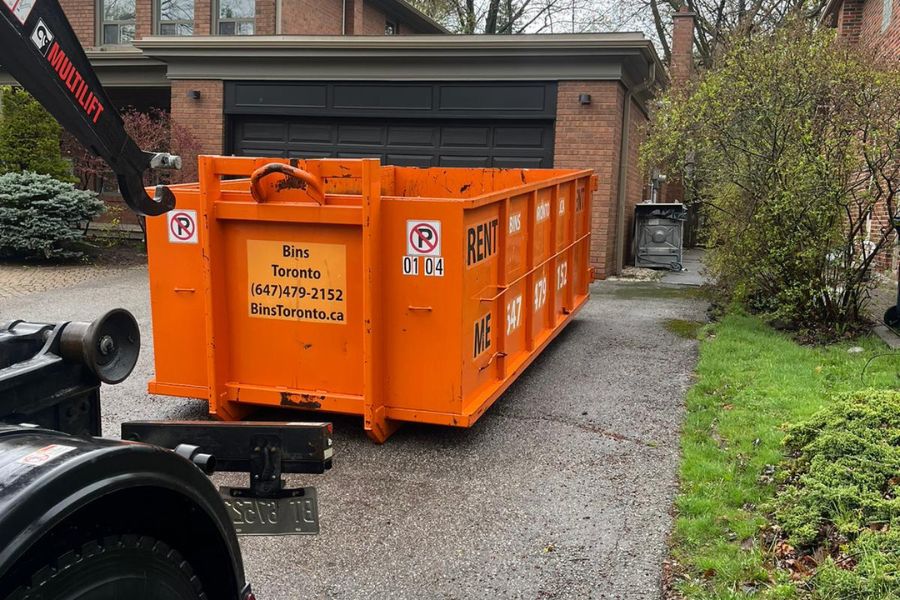
We are in the business of renting bins, but we are also in the business of giving good advice. Sometimes, the smartest move is to keep the dumpster off your property entirely. If you really want to know how to protect a driveway from dumpster damage, sometimes the answer is: don’t put it on the driveway.
We strongly recommend getting a Street Occupation Permit from the City of Toronto if:
Getting a permit is easier than you think. You apply online, pay a fee (usually under $100, depending on the duration), and you save yourself the stress.
We know that renting a dumpster is just one small part of your massive renovation project. You are worried about contractors, budgets, timelines, and paint colors. It is easy to overlook the driveway.
But take it from us: spending $50 on plywood and taking ten minutes to talk to your driver is the best insurance policy you can buy. It saves you from the heartbreak of damaging your home in the process of trying to improve it. Understanding how to protect a driveway from dumpster damage is the mark of a pro DIYer.
At Bins Toronto, we pride ourselves on being careful. Our drivers are skilled pros who know how to navigate tight Toronto alleys and pristine suburban driveways. But we work best when we work with you.
Are you ready to clear out that clutter without the stress? Contact us today. Let us know you read this guide, and we’ll help you choose the perfect bin and the perfect spot for your project.