
October 08, 2026
Premier Bin rental Service in Toronto and the GTA
Last updated:
The residential vs commercial dumpster question has a short answer and a long one. The short answer is that the difference is not really about who rents the bin. It is about weight allowance, accepted material and placement footprint, and those three factors decide the right container far more reliably than whether the address is a house or a job site. A homeowner gutting a bungalow may need what our dumpster bin rental service would classify as a commercial bin, and a small office refit may be perfectly served by a residential one.
The long answer is worth understanding, because choosing the wrong category is the most common way a disposal budget gets away from a project.
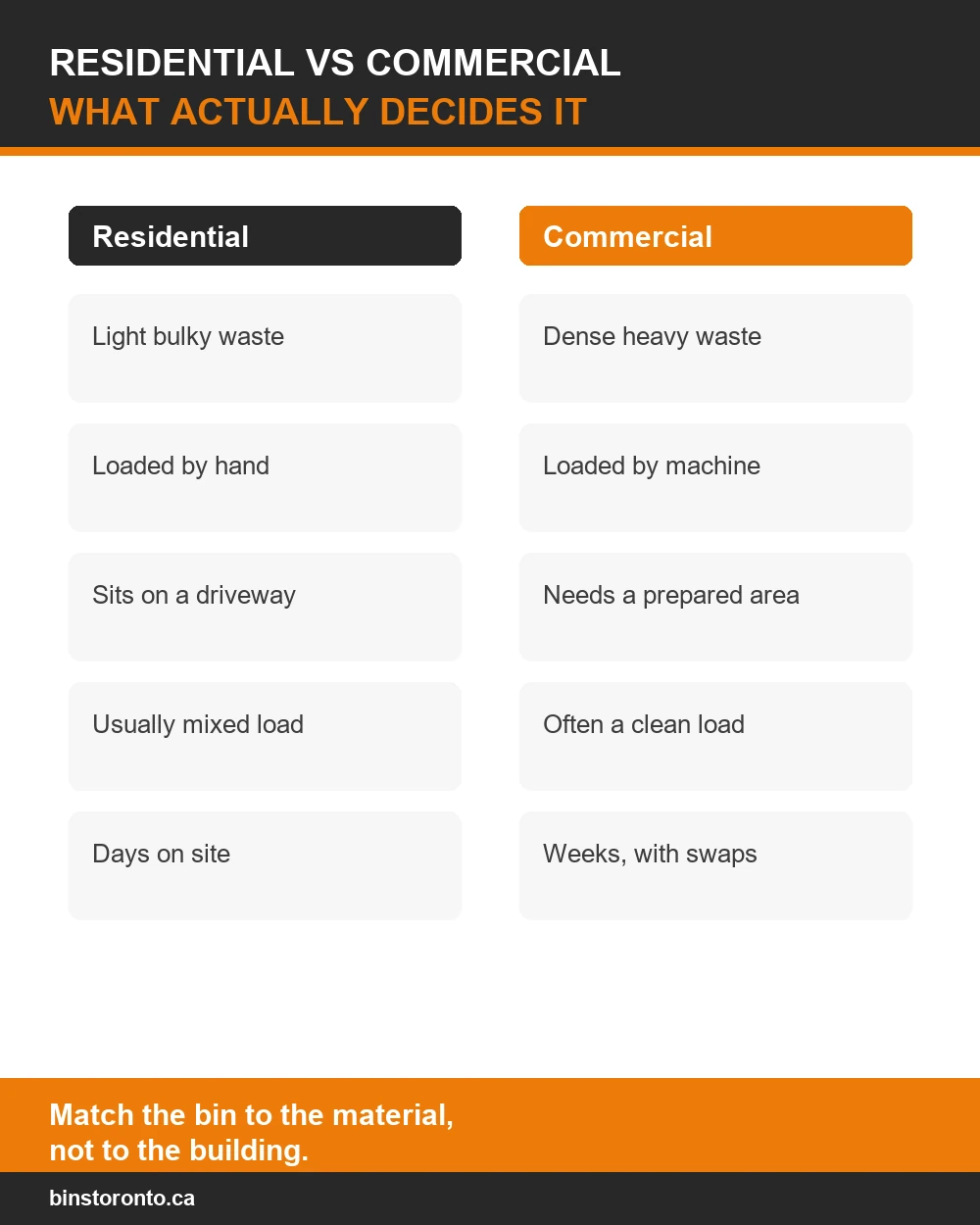
Match the bin to the material, not to the building. Heavy, dense and homogeneous waste points toward a commercial dumpster and a clean load. Light, bulky and mixed waste points toward a residential bin. Everything else is detail.
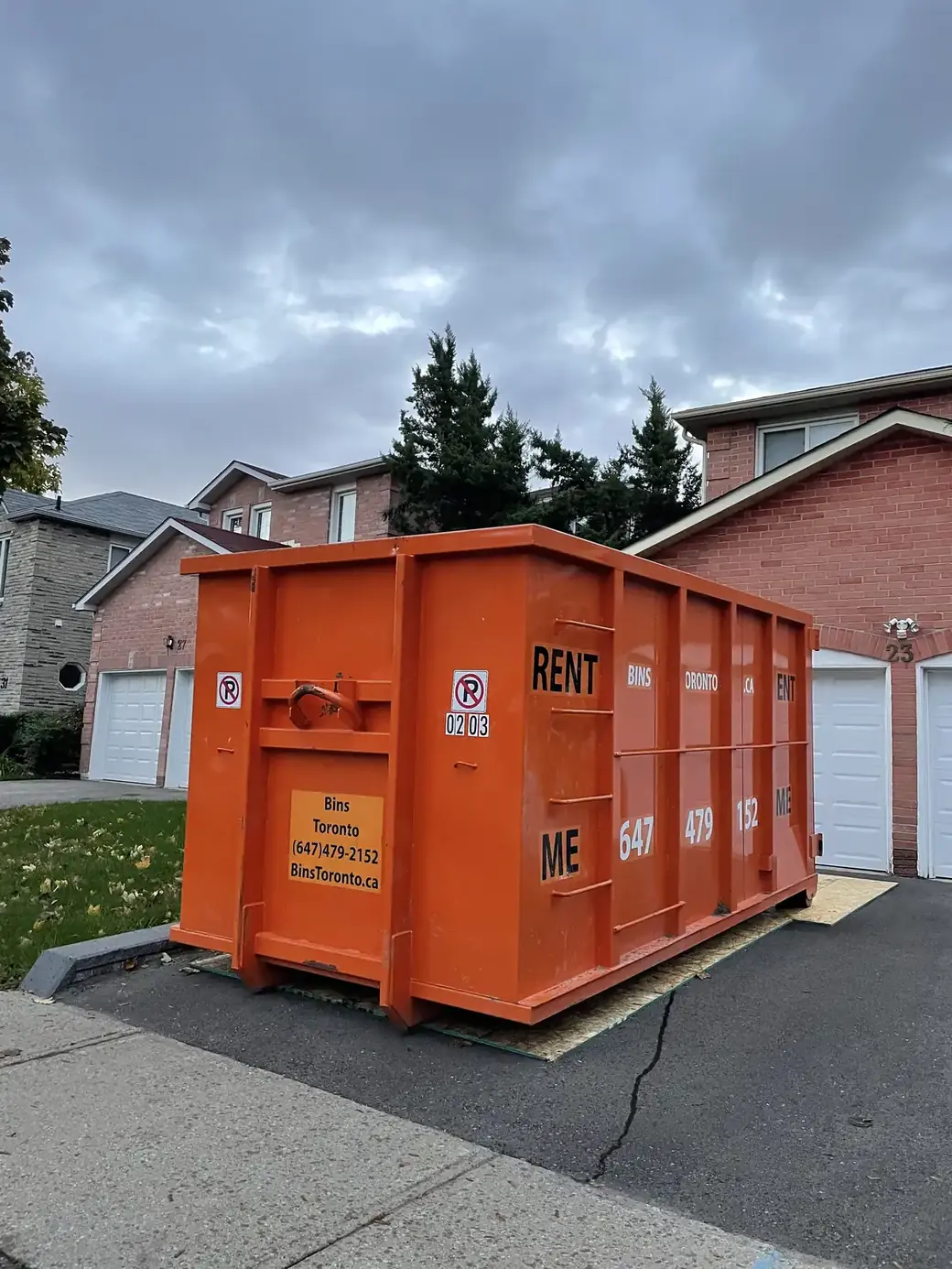
Residential bins are built for volume without much weight. Household renovation debris is bulky and comparatively light: cabinetry, drywall, flooring, furniture, packaging. A residential bin gives a homeowner enough room for that material while staying small enough to sit on a driveway without damaging it.
A commercial dumpster is built for the opposite problem. Construction and demolition waste is dense. Concrete, brick, block, tile, asphalt and soil are heavy enough that a bin reaches its legal transport weight long before it looks full. A commercial dumpster therefore has reinforced floors and walls, a higher weight allowance, and a shape designed to be loaded by machine rather than by hand.
The visible differences follow from that engineering. A commercial dumpster runs longer and is frequently lower-sided, because a lower wall lets an excavator or skid steer reach over the edge. Residential bins are shorter and often include a swinging rear door at ground level, which matters enormously when the loading is being done by two people with a wheelbarrow.
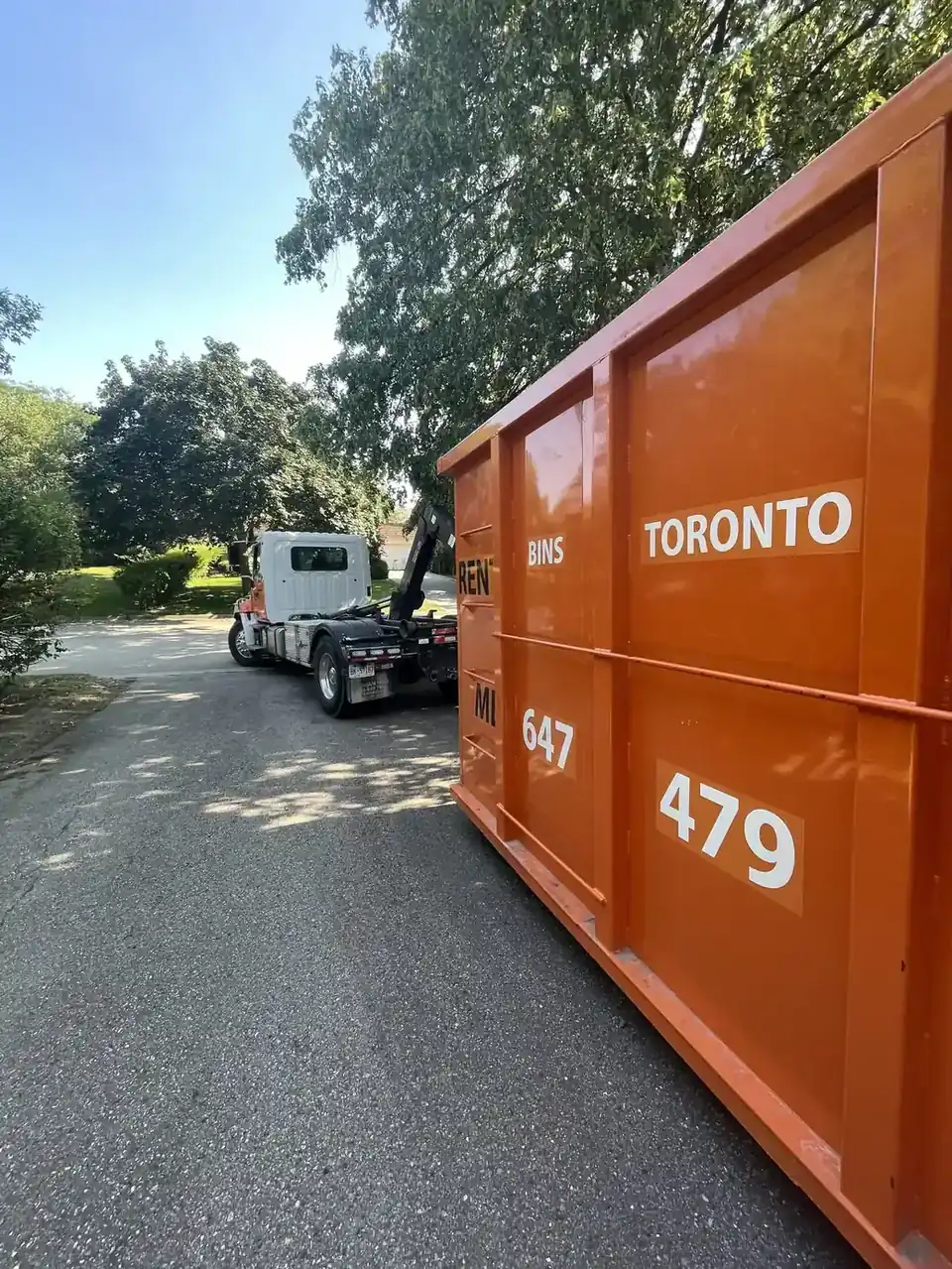
Placement is where the difference becomes concrete for most people. A residential bin needs a driveway. A large commercial dumpster needs a prepared area, truck access with overhead clearance, and enough straight-line room for the truck to winch the container off and back on. Overhead wires, tree canopy and a tight turning radius rule out a large commercial dumpster on a great many residential streets. Our six bin sizes exist precisely because that spectrum is continuous rather than binary.
Measure the placement area before booking, not after. You need the length of the commercial dumpster plus roughly the same distance again in clear space behind it for the delivery truck to load and unload. A driveway that fits the bin but not the truck is a wasted delivery and, in most cases, a wasted trip charge.
This is the difference that costs money when it is misunderstood. Bins are not neutral containers that accept anything placed inside them. What goes in determines where the load can legally be taken, and therefore what it costs to process.
| Material | Residential mixed bin | Commercial dumpster |
|---|---|---|
| Drywall, lumber, flooring | Yes | Yes |
| Furniture and appliances | Yes | Generally avoided |
| Concrete, brick, asphalt | No, use a clean load | Yes, as a clean load |
| Soil and fill | No | Yes, with regulatory handling |
| Roofing shingles | Yes, in limited volume | Yes |
| Hazardous material and asbestos | Never | Never |
| Typical loading method | By hand | By machine |
The row that catches people is concrete. Placing aggregate in a mixed residential bin does not simply add weight. It removes the entire load from the aggregate recycling stream, which is the stream that would have made that material inexpensive to dispose of in the first place. In a commercial dumpster kept as a dedicated clean load, that same concrete is among the cheapest material you can move. Our tri-axle and dump truck service exists for exactly the loads that outgrow a bin entirely.
Here is the structural difference that rarely appears in a comparison of bin sizes, and it is the one that genuinely separates residential work from commercial work in Ontario.
Commercial and institutional projects carry legal waste obligations that homeowners do not. Under Ontario Regulation 102/94, a demolition project involving one or more buildings with a combined floor area of at least 2,000 square metres requires a waste audit and a written waste reduction work plan, and both must be completed before demolition work begins on site. Designated industrial, commercial and institutional operations carry ongoing source separation obligations for recyclable materials as well.
A homeowner renovating a kitchen has no equivalent duty. This is why the phrase commercial dumpster means something beyond size: it frequently signals a project operating inside a compliance framework, where documentation of where the waste went is part of the job rather than an afterthought.
A common question is whether a residential property can ever trigger these obligations. In practice the 2,000 square metre threshold puts ordinary house demolition well outside the requirement. Large multi-unit residential demolition is a different matter, and on those projects the waste audit is handled by the demolition contractor as a matter of course.
| Residential bin | Commercial dumpster | |
|---|---|---|
| Designed for | Bulky, light household debris | Dense construction and demolition waste |
| Weight allowance | Lower | Substantially higher |
| Loading | By hand, often via a rear door | By excavator or skid steer |
| Placement | Standard driveway | Prepared area with truck access |
| Typical duration | Days | Weeks, with swaps |
| Load type | Usually mixed | Often clean and separated |
| Compliance duties | None for homeowners | Possible audit and reporting duties |
Read down the weight allowance row first. If your material is heavy, that row decides the question and the rest is commentary.
Work through these in order. The first one that applies gives you the answer.
Sites that need machine loading usually need the machine too. If the project is large enough to warrant a commercial dumpster, our construction equipment rental range covers the loaders and excavators that make filling one practical. For a residential clear-out where nobody wants to handle the loading at all, full-service junk removal is the better fit.
Projects in denser parts of the city carry an additional constraint that has nothing to do with the bin itself. Where a driveway cannot take a container at all, placement moves to the road allowance and a permit enters the picture, which is a scheduling matter as much as a cost one. Our guide on dumpster permits for street placement covers how that process runs. Sites in the newer subdivisions of Vaughan rarely hit that problem, while older infill lots in the core almost always do.
This article is for general guidance only. Regulations, thresholds and disposal requirements change, and the summary of Ontario Regulation 102/94 here is not legal advice. Bins Toronto is not liable for outcomes from actions taken based on this content. Confirm current obligations with the Government of Ontario and with a qualified professional for your specific project.
Download the free quick guide
A one-page decision matrix comparing residential and commercial bins across weight, material, placement and compliance, sized to print and pin up on site.
Download the bin selection reference sheet (PDF)The residential vs commercial dumpster decision comes down to one question asked honestly: how heavy is the material, and how will it get into the bin? Answer those two and the correct container is rarely ambiguous. Everything else, including the label on the category, is secondary.
Bins Toronto supplies both a residential bin and a commercial dumpster across Toronto and the GTA, including Scarborough, Etobicoke and Markham. Check the full list of areas we deliver to, and if you are uncertain which side of the line your project falls on, book your bin rental online or talk it through with our team before the material starts moving.